
Yes, you can enjoy gaming completely alone.
Many games provide full stories, meaningful challenges, exploration, progression, and long-term goals without requiring friends, strangers, or an online community. You do not need to join a team, use voice chat, or arrange your schedule around other players.
However, a game offering a “solo” option does not always guarantee a complete solo experience. Some games allow you to begin alone but eventually restrict progress, place major activities behind group requirements, or make solo play unnecessarily difficult.
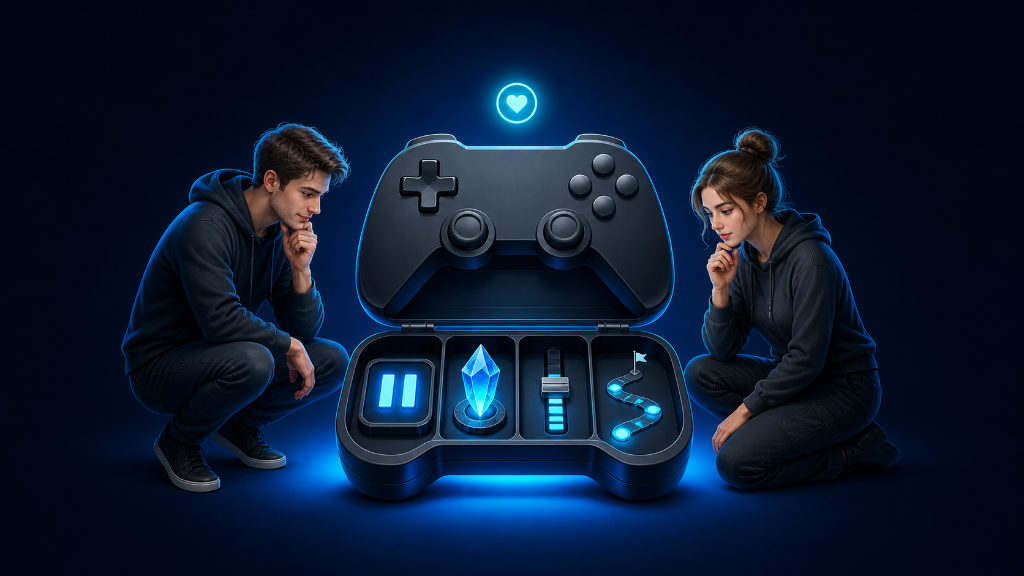
The Solo-Friendly Feature Check helps you identify games that genuinely support independent play. Before choosing a game, confirm that it offers:
- A complete solo mode
- Independent progression
- Adjustable difficulty
- Practical pause or save options
- No required group content
The first, second, and fifth features determine whether the game is structurally suitable for solo play. Adjustable difficulty and pause or save options determine how comfortably it fits your experience and schedule.
If you are deciding how much—or how little—social interaction you want from gaming, our Beginner’s Guide to Social Gaming (Play Alone or With Others Without Pressure) walks you through the basics.
“Playable Alone” Is Not Always the Same as Solo-Friendly
Imagine finding a game with a fascinating world and an appealing description. Its store page says it can be played alone, so you assume you can move through the entire experience independently.
The first few hours go well. Then progress slows. Important activities require a team, valuable rewards are tied to multiplayer events, or a difficult section appears designed around several players working together.
Technically, you were allowed to play alone. Practically, the experience depended on other people.
This difference matters because “solo-compatible” and “solo-friendly” describe two different things.
A solo-compatible game permits one person to enter. A solo-friendly game builds the experience around that person’s ability to progress, learn, pause, save, and reach a satisfying conclusion independently.
The distinction can prevent wasted money and frustration. Instead of asking only whether solo mode exists, examine what that mode actually lets you accomplish.
Look for the Five Signs of a Complete Solo Experience
1. A Complete Solo Mode
A complete solo mode gives you a meaningful experience rather than a shortened demonstration of the multiplayer game.
Look for a clear individual activity, such as:
- A full story or campaign
- A series of independent challenges
- A world you can explore alone
- Building, collecting, or management goals
- Computer-controlled teammates or opponents
- A defined path toward completion or continued play
The central question is simple: Does the game’s main activity remain enjoyable when no other players are present?
A strong solo mode should not make you feel as though you are waiting for the “real” game to begin.
2. Independent Progression
Progression is how the game recognizes your effort. It might involve advancing a story, developing a character, unlocking equipment, improving a settlement, completing levels, or learning more advanced skills.
A solo-friendly game lets you make meaningful progress at your own pace.
Before choosing it, check whether you can:
- Unlock important features alone
- Reach the main goals without a team
- Earn useful rewards through solo activities
- Return after a break without falling permanently behind
- Improve through practice rather than social access
Optional group activities are not a problem. They become a problem when they control the progress you care about.
If independent play repeatedly leads to dead ends, the game is group-dependent even if solo entry is technically possible.
3. Adjustable Difficulty
Difficulty controls help you shape the challenge around your current experience.
Useful options may include selectable difficulty levels, aim assistance, control customization, navigation aids, puzzle hints, reduced penalties, or settings that make timing more forgiving.
These options are especially valuable when playing alone because another person will not be present to compensate for a difficult section or explain an unfamiliar system.
A game does not need every accessibility or difficulty option to be enjoyable. However, beginners should understand what happens when the challenge becomes frustrating.
Ask:
- Can I lower the difficulty?
- Can I retry without losing significant progress?
- Does the game teach its systems clearly?
- Are hints or assistance available?
If the answer is no, the game may still be solo-friendly—but expect a steeper learning curve.
4. Practical Pause or Save Options
Solo gaming should fit your life rather than hold your time hostage.
A traditional pause feature lets you stop immediately. A manual save lets you preserve your exact position. Automatic checkpoints record progress at planned intervals. Some games use only one of these systems.
Before starting, determine:
- Can I pause during ordinary play?
- Can I save when I need to stop?
- How much progress could I lose?
- How long does a typical activity take?
- Can I leave without inconveniencing anyone?
A game without a pause button can still fit solo play if it saves frequently and offers safe stopping points. A game with long gaps between saves may require more uninterrupted time than expected.
This feature does not determine whether solo play is possible. It determines whether solo play will remain comfortable over time.
5. No Required Group Content
The final essential check is whether other players are required to experience the parts of the game that matter to you.
Separate optional social features from actual group requirements.
Optional features might include:
- Cooperative side activities
- Competitive modes
- Community events
- Trading
- Shared spaces
- Leaderboards
Required group content might include:
- Mandatory team missions
- Progress locked behind multiplayer victories
- Challenges balanced for coordinated groups
- Scheduled activities needed for major rewards
- Systems that cannot function without other players
You do not need access to every optional reward for a game to be solo-friendly. You do need an independent path to the experience you purchased the game to enjoy.
Decide which goals matter to you, and confirm that none of them requires a group.
Is This Game Truly Solo-Friendly?
Use the following checklist before buying, downloading, or committing significant time.
Essential solo features
- The main activity remains meaningful when played alone.
- I can make progress toward my primary goal independently.
- The content I care about does not require a group.
If any of these statements is false, the game is not a reliable solo-first choice for your intended goal.
Comfort features
- The challenge can be adjusted or made easier to learn.
- I can pause, save, or reach stopping points that fit my schedule.
Missing one comfort feature does not automatically disqualify the game. It reveals a tradeoff you should understand before starting.
Your result
Solo-Friendly
All three essential features and both comfort features are present.
You can expect a complete independent experience with manageable difficulty and flexible stopping points.
Where to start: Begin with the main solo mode and adjust the settings before the first session.
Solo-Capable With Tradeoffs
All three essential features are present, but one or both comfort features are limited.
You should be able to enjoy the game alone, although it may demand more patience, practice, or uninterrupted time.
Where to start: Learn how difficulty, saving, and checkpoints work before committing to a long session.
Group-Dependent
At least one essential solo feature is missing.
The game may allow individual play, but the experience or progress you want eventually depends on other people.
Where to start: Choose a different game if independence is important, or continue only if you are comfortable using matchmaking or finding a group.
Do not select a game merely because someone says it has solo play. Select it because its solo systems support the specific experience you want.
Choose a Game That Works on Your Terms
A solo-friendly game is like a good book: it is ready whenever you are and never requires everyone else to arrive.
Choose one game and run it through the five feature checks. Confirm the three essentials first: a complete solo mode, independent progression, and no required group content.
Then examine the two comfort features. Learn how the game handles difficulty, pausing, saving, and stopping points so its demands do not surprise you.
For your first session:
- Adjust the settings before beginning.
- Choose one small objective.
- Play long enough to experience the central activity.
- Stop at the next convenient save point.
- Decide whether you enjoyed the game itself—not merely the idea of playing it.
If the experience feels complete, understandable, and manageable alone, you have found an appropriate starting point.
You do not need friends to make gaming enjoyable. You need a game that respects your independence, experience level, and available time.
After finding a game you can confidently enjoy alone, discover more beginner-friendly guidance on our Gaming 101 category page.
Leave a Reply