
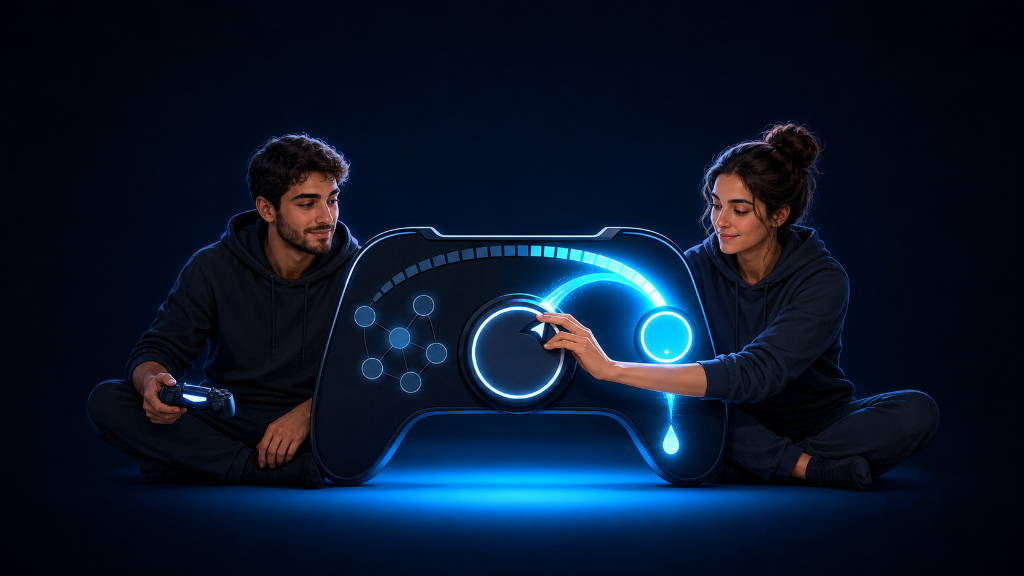
If social gaming has started to feel exhausting, pause the social pressure before deciding that gaming itself is the problem.
Return to solo play for a defined period. Use that time to determine whether the drain came from communication, schedules, performance pressure, session length, or a mismatched group.
Then reintroduce only one social variable during one short session.
This is the Solo-Baseline Reset Rule:
- Diagnose the likely source of the drain.
- Pause nonessential social play.
- Restore a comfortable solo baseline.
- Reintroduce one social variable.
- Keep, reduce, or remove it based on the result.
The goal is not to avoid other players permanently. It is to separate enjoyable connection from the conditions that turned gaming into an obligation.
If you want a broader introduction to balancing independent and social play, our Beginner’s Guide to Social Gaming (Play Alone or With Others Without Pressure) walks you through the basics.
Relief Does Not Always Reveal the Cause
Imagine finishing another scheduled group session feeling more tired than entertained.
You enjoyed parts of the game, but voice chat never stopped. The group played longer than expected, mistakes became serious, and leaving early felt impolite.
You decide to play alone the next night. The relief is immediate.
That relief confirms that something about the social experience caused the problem. It does not reveal which part.
If you remove voice chat, group scheduling, competition, long sessions, and specific players simultaneously, you cannot tell what needs to change. Returning to the same arrangement may recreate the drain, while avoiding every social feature may remove interactions you would have enjoyed under better conditions.
A solo baseline creates a stable comparison point. Once gaming feels voluntary again, you can restore one social element and observe its effect.
That turns a general feeling—“social gaming drains me”—into a specific, fixable problem.
Diagnose the Drain, Reset, and Reintroduce
Cause 1: Communication Overload
Communication overload occurs when conversation demands more attention than you want to give.
Signs include:
- Voice chat feels more tiring than the game.
- You struggle to listen, respond, and play simultaneously.
- Messages continue after the session.
- Muting communication creates immediate relief.
- You avoid playing because you do not want to talk.
The correction: Replace voice chat with text, predefined signals, or no communication.
If text also becomes distracting, restrict it to task-related messages. Social gaming can still work without continuous conversation.
Next-time prevention: Choose the lowest communication level needed for the activity and increase it only when it improves the experience.
Cause 2: Schedule Pressure
A recurring session can slowly turn recreation into an appointment.
Signs include:
- You feel guilty about missing a session.
- Gaming competes with rest or other responsibilities.
- A cancelled event produces relief.
- The group expects regular attendance.
- You play because others are waiting rather than because you want to.
The correction: Pause recurring commitments and return through spontaneous invitations or temporary matchmaking.
If you later accept another schedule, confirm that attendance is optional and that declining will not harm the group.
Next-time prevention: Commit only to schedules you can miss without conflict, guilt, or lost progress.
Cause 3: Performance Pressure
Competition and team responsibility can make every mistake feel expensive.
Signs include:
- You worry about disappointing teammates.
- Losses affect your mood long after playing.
- You continue only to recover a rank or result.
- Ordinary mistakes attract criticism.
- You focus more on avoiding failure than enjoying the activity.
The correction: Return through casual, cooperative, training, or unranked modes.
You can preserve shared play while removing the stakes that created the pressure.
Next-time prevention: Keep competitive sessions limited and maintain at least one social mode where success does not depend on rank.
Cause 4: Session-Length Overload
The interaction may be enjoyable at first but continue beyond your available energy.
Signs include:
- The opening activity feels good.
- Fatigue appears after several consecutive sessions.
- “One more” repeatedly extends the stopping time.
- You remain because other players are not ready to leave.
- You need a long recovery after playing.
The correction: Set a one-activity limit or a clear stopping time before joining.
State the boundary simply: “I can play one match,” or “I need to stop at nine.”
Next-time prevention: Choose activities with predictable endpoints and leave when the stated boundary arrives.
Cause 5: Group Mismatch
Sometimes social gaming is not the problem. One particular group is.
Signs include:
- You feel comfortable with some players but drained by others.
- The group ignores your communication boundaries.
- Its pace, humor, or expectations do not fit.
- You feel pressure to act differently to remain included.
- Sessions leave you tense even when the game goes well.
The correction: Reduce contact with the mismatched group and test social play with different people or temporary teammates.
Use mute, block, report, and leave controls when someone becomes abusive or intrusive.
Next-time prevention: Judge compatibility by repeated respect for your time, boundaries, skill level, and communication preferences.
Establish Your Solo Baseline
Choose a defined reset period, such as the next three gaming sessions or one week.
During that period:
- Disable nonessential communication.
- Pause recurring group activities.
- Select a game or mode with meaningful solo play.
- Play only when you feel interested.
- Stop when you want to stop.
- Notice your enjoyment and energy afterward.
The baseline is restored when gaming feels manageable and voluntary again. If gaming itself still feels unappealing, take a broader break instead of forcing solo sessions.
Reintroduce One Social Variable
Choose only one variable to test:
- Anonymous matchmaking
- Text chat
- Voice chat
- Competitive play
- A longer session
- A scheduled activity
- A familiar group
Keep the remaining conditions close to your solo baseline.
For example, if testing text chat, keep the session short, casual, and unscheduled. If testing a familiar group, use minimal communication and a predictable endpoint.
Afterward, compare the session with your baseline:
- Was I interested before playing?
- Did I feel in control during the session?
- Did the social element improve the experience?
- How was my energy afterward?
- Would I willingly repeat the same setup?
Choose one response:
- Keep it: The variable improved the experience without significant drain.
- Reduce it: The variable helped but needs lower intensity or less time.
- Remove it: The original pressure returned.
Match the Drain to One Change
“Voice chat tires me more than playing.”
- Likely cause: Communication overload
- Fix: Move to text or predefined signals.
- Next attempt: Keep voice optional.
“I dread scheduled sessions.”
- Likely cause: Schedule pressure
- Fix: Pause recurring activities.
- Next attempt: Use spontaneous matchmaking or optional invitations.
“I feel responsible for every loss.”
- Likely cause: Performance pressure
- Fix: Switch to casual or cooperative play.
- Next attempt: Separate social connection from rank.
“Sessions begin well but end badly.”
- Likely cause: Session-length overload
- Fix: Set one activity or a firm stopping time.
- Next attempt: State the limit before joining.
“Only one group leaves me exhausted.”
- Likely cause: Group mismatch
- Fix: Step away from that group.
- Next attempt: Test the same game with different players.
“Every social format currently feels tiring.”
- Likely cause: The baseline has not recovered.
- Fix: Extend the solo period or take a complete break.
- Next attempt: Return only when interest replaces obligation.
“The drain returns after I restore one feature.”
- Likely cause: The reintroduced variable
- Fix: Reduce or remove that variable.
- Next attempt: Keep the other conditions unchanged while confirming the result.
Rebuild From a Comfortable Baseline
Resetting social gaming is like lowering the volume: find a comfortable baseline before turning one dial back up.
Choose a defined solo period and remove nonessential social demands. Once gaming feels voluntary again, select one social variable and test it during one short session.
Keep what improves the experience. Reduce what requires too much energy. Remove what recreates the original pressure.
Social gaming should add connection to the hobby—not turn enjoyment into attendance, performance, or obligation.
After restoring a healthier balance between solo and social play, continue building your confidence with more beginner-friendly guidance on our Gaming 101 category page.
Leave a Reply