
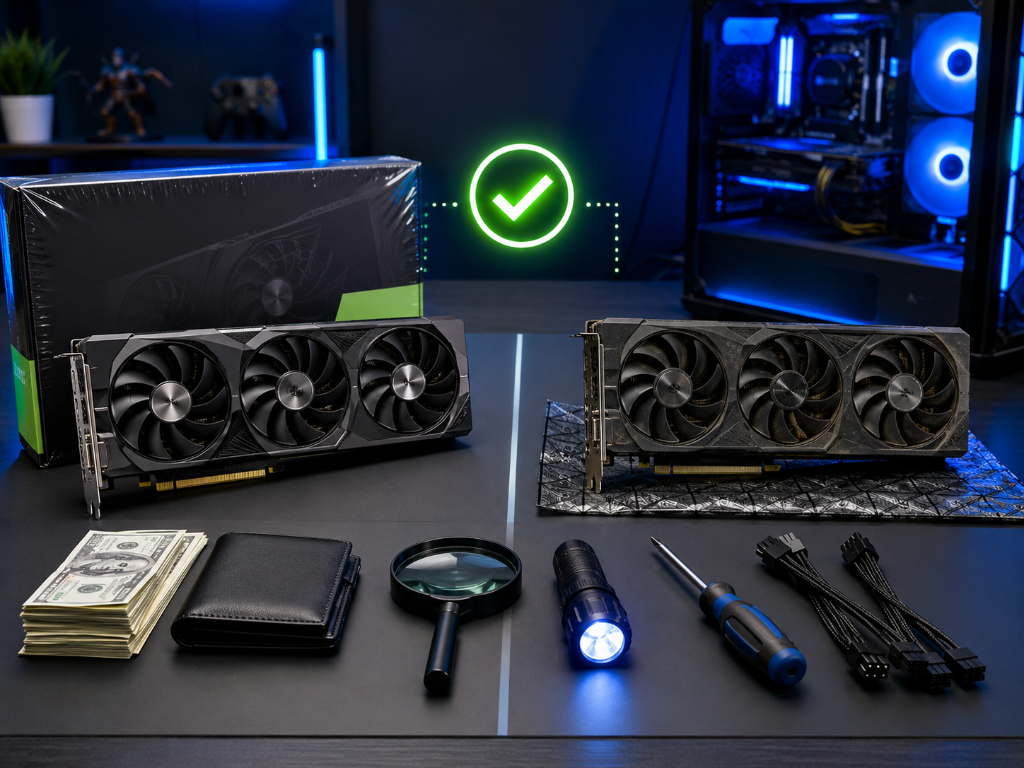
One of the biggest temptations for beginners building a gaming PC is the used GPU market.
The prices look better.
The performance sometimes looks surprisingly close to newer cards.
And suddenly beginners start wondering:
“Why buy new if I can save money?”
“Is used hardware risky?”
“Am I making a mistake either way?”
For video games as a hobby, this decision is less about finding the “perfect” answer and more about understanding tradeoffs clearly.
A used GPU can absolutely be a smart beginner purchase.
But beginners should understand that lower prices usually come with more uncertainty.
The goal is not to avoid all risks completely.
The goal is to decide whether the savings are worth the added responsibility, reduced warranty protection, and possible troubleshooting.
If you’re still learning how gaming graphics cards affect performance and reliability, our Beginner’s Guide to Gaming GPUs can help you understand the basics before comparing used and new hardware.
The Beginner Chasing the Cheapest Deal
Imagine a beginner building their first gaming PC on a tight budget.
They find two graphics cards.
One is brand new.
The other is used and much cheaper.
The beginner immediately focuses on performance comparisons and starts thinking:
“The used GPU seems like a better deal.”
But then doubts appear.
What if the GPU was heavily used?
What if it overheats?
What if it fails shortly after buying it?
What if something is wrong that they cannot recognize yet?
The beginner starts bouncing between fear and excitement.
Now imagine a more methodical beginner.
Instead of asking:
“Which GPU is cheaper?”
They ask:
“What level of risk am I comfortable managing as a beginner?”
That changes the decision completely.
They realize a used GPU is not automatically bad, and a new GPU is not automatically necessary.
The real difference is predictability.
A new GPU usually offers:
- Warranty protection
- Better reliability expectations
- Simpler buying decisions
- Lower troubleshooting risk
- Longer expected support life
A used GPU usually offers:
- Better price-to-performance
- More budget flexibility
- Access to stronger hardware for less money
The beginner now sees the tradeoff clearly instead of emotionally.
Used GPUs Are About Risk Tolerance, Not Just Savings
For beginners, used GPUs make the most sense when the savings are meaningful enough to justify the added uncertainty.
This creates a simple beginner decision rule:
If buying used creates too much stress or uncertainty, the savings may not be worth it yet.
That matters because beginners are still learning:
- GPU performance expectations
- Compatibility checks
- Cooling behavior
- Hardware troubleshooting
- Driver management
- Upgrade planning
A new GPU reduces many of those variables.
That simplicity can be valuable for first-time builders.
However, used GPUs can still be excellent beginner options when approached carefully.
Good beginner-friendly buying rules include:
- Buy from trusted sellers with ratings or history
- Avoid deals that seem unrealistically cheap
- Check for physical damage or missing parts
- Ask whether the GPU was used for mining or heavy workloads
- Look for testing videos, benchmarks, or screenshots when possible
- Prioritize GPUs with remaining warranty coverage if available
- Verify the GPU model carefully before paying
Another important beginner expectation:
A used GPU does not need to be “perfect” to create a great gaming experience.
For many hobby gamers, a reliable second-hand GPU can provide smooth and enjoyable gaming for years.
At the same time, beginners should understand when buying new may be the safer choice:
- If you want lower stress
- If you are uncomfortable troubleshooting
- If warranty support matters heavily to you
- If the used savings are relatively small
The key is understanding that you are trading some predictability for savings.
That is the real tradeoff.
Choose the Option That Matches Your Comfort Level
Buying a used GPU is like buying a pre-owned car: a good one can save you a lot of money and still perform reliably, but the lower price usually comes with more responsibility, inspection, and uncertainty compared to buying new.
Before choosing between a used or new GPU, ask yourself:
- Is my budget tight enough that the savings truly matter?
- Am I comfortable handling possible troubleshooting?
- Do I value lower stress more than maximum savings?
- Would I rather pay more for warranty support and simplicity?
- Am I buying for short-term value or long-term reliability?
Then choose the option that matches your comfort level as a beginner.
You do not need the “perfect” buying strategy to start gaming correctly.
You simply need a setup decision that feels practical, manageable, and comfortable for your current experience level.
After choosing the GPU buying approach that fits your budget and confidence level, explore more practical upgrade and optimization strategies in our Setup Zone category page.
Leave a Reply