
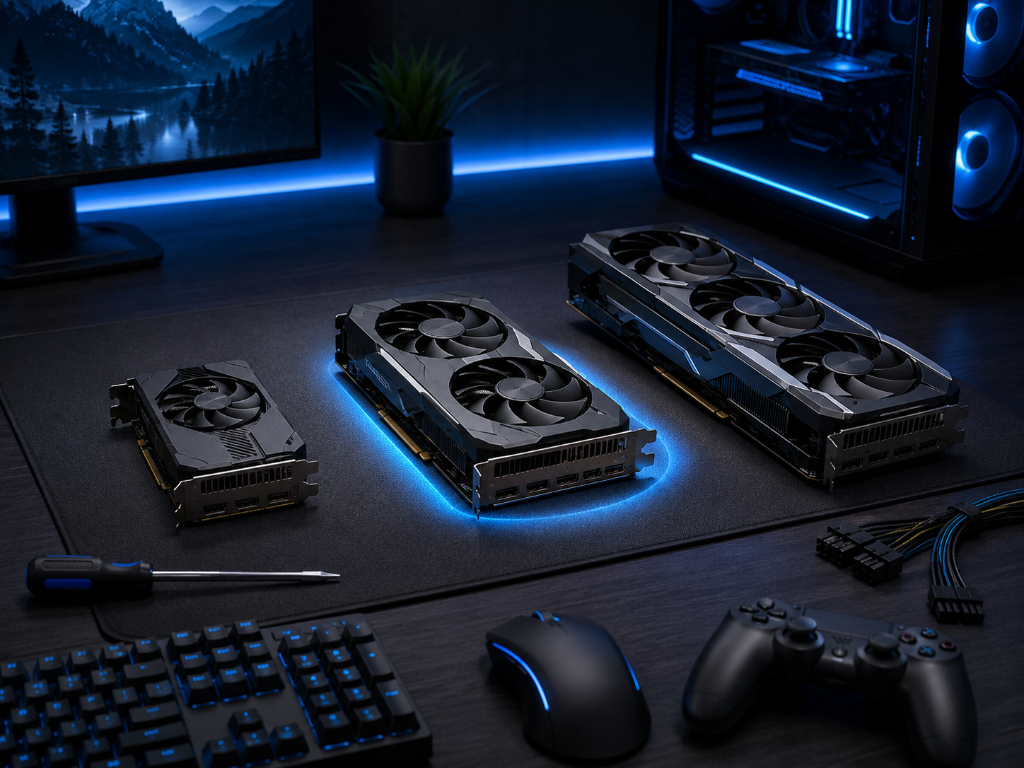
One of the most confusing parts of building a gaming setup is understanding GPU tiers.
Beginners constantly hear terms like “entry-level,” “mid-range,” and “high-end,” but those labels often create more pressure than clarity.
A beginner sees expensive GPUs online and starts wondering:
“Is entry-level too weak?”
“Will I regret not buying high-end?”
“Am I already falling behind?”
But for video games as a hobby, the best GPU tier is not the most powerful one.
It is the one that matches your actual gaming goals.
A beginner-focused setup does not need to compete with enthusiast builds on the internet.
It only needs to create a smooth, enjoyable, and reliable gaming experience for the games you actually want to play.
That is the real starting point.
If you’re still learning how gaming graphics cards affect performance, our Beginner’s Guide to Gaming GPUs can help you understand the basics before comparing GPU tiers.
Buy for Your Games, Not Internet Pressure
Imagine a beginner researching gaming PCs for the first time.
Every video they watch seems to recommend stronger hardware.
One creator says mid-range is the “minimum.”
Another says high-end GPUs are the only way to “future-proof” a setup.
The beginner starts feeling like entry-level hardware is automatically bad.
So they begin looking at GPUs far beyond their original budget.
Now imagine a more methodical beginner.
Instead of focusing on GPU labels, they focus on outcomes.
They ask:
“What type of gaming experience am I actually trying to create?”
They realize they mostly want to:
- Explore gaming casually
- Play comfortably at 1080p
- Enjoy smooth gameplay
- Build a balanced setup without overspending
That changes the decision completely.
Instead of chasing the strongest GPU possible, they choose hardware that matches their actual needs.
The result feels practical instead of overwhelming.
Their games still run smoothly.
Their setup still feels exciting.
But their budget stays balanced and easier to manage.
Match the GPU Tier to the Experience You Want
GPU tiers make more sense when you stop treating them like status levels.
They are simply different performance categories built for different gaming goals.
Entry-level GPUs are usually best for:
- Beginner gaming setups
- Indie games
- Esports titles
- Older games
- Lighter gaming workloads
- Budget-focused builds
The main outcome is:
Affordable access to PC gaming without overspending.
Mid-range GPUs are often the best balance for most hobby gamers because they combine:
- Strong 1080p or 1440p gaming
- Better long-term flexibility
- Comfortable graphics settings
- Stable overall performance
- Balanced pricing
The main outcome is:
A smoother long-term gaming experience without entering enthusiast-level pricing.
High-end GPUs are designed more for enthusiasts who want:
- Maximum graphics settings
- High resolutions like 4K
- Competitive frame rates
- Heavy mods or VR
- Advanced visual features
- Specialized performance goals
The main outcome is:
Maximum performance for demanding gaming situations.
That does not mean beginners should avoid high-end hardware completely.
It simply means beginners should not assume high-end automatically equals “correct.”
A useful beginner decision rule is this:
If the GPU comfortably runs the games you want at the quality level you enjoy, it is already doing its job.
That is what matters most.
Another important expectation:
Your monitor matters too.
A beginner using a 1080p monitor usually does not need the same GPU tier as someone gaming at 1440p or 4K.
Higher resolutions demand more GPU power.
For many beginners, a balanced mid-range or even entry-level GPU creates a better overall hobby experience than overspending on performance they may never fully use.
Choose the GPU Tier That Fits Your Gaming Goals
Entry-level, mid-range, and high-end GPUs are like apartment sizes: entry-level covers the essentials, mid-range gives most people comfortable space, and high-end is built for people who specifically want maximum room, features, and flexibility.
Before comparing GPU models, define your gaming goals first.
Write down:
- The games you want to play
- Your monitor resolution
- Whether you care more about visuals, smoothness, or budget balance
- Whether gaming is casual, competitive, or becoming a long-term hobby
Then match the GPU tier to those goals instead of internet hype.
You do not need the “best” GPU to start gaming correctly.
You need the right level of performance for the experience you actually want to build.
After choosing the GPU tier that fits your gaming goals, explore more practical setup strategies in our Setup Zone category page.
Leave a Reply