
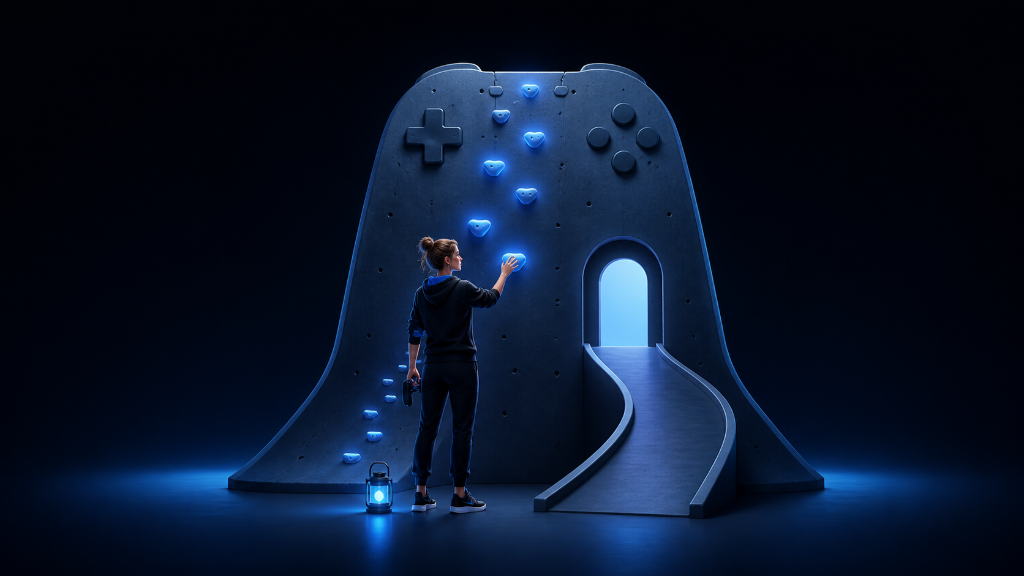
Keep playing if a fixable barrier is hiding an experience you still want. Consider quitting if you understand the game, test a reasonable correction, and still dislike what it asks you to do.
Do not make the decision during your most frustrating attempt. Identify the likely problem, apply one matching fix, and retest the game under better conditions.
Quitting one game does not mean gaming is wrong for you. It may only mean that this game’s activities, demands, or structure are not the right fit.
If you need help finding a clearer starting direction, our Beginner’s Guide to Starting Video Games (Where to Begin & What to Do First) walks you through the basics.
The Wall Might Not Be the Whole Game
Imagine enjoying a game’s world, exploration, and story until one difficult encounter stops all progress.
You understand the objective, but the encounter ends before you can practice. Lowering the difficulty gives you enough time to recognize patterns and make decisions. The game becomes enjoyable again.
The difficulty was a barrier, not a reason to quit.
Now imagine making the same adjustment in another game. You can progress, but you still dislike the repeated combat, puzzles, or resource management. Removing the difficulty does not create interest.
The barrier was not the main problem. The game was a poor fit.
The Barrier–Fit Recovery Test helps you determine which situation you are facing.
Separate the Barrier From the Fit
1. Identify the likely contributor
Replace “this game is too hard” with a specific description.
Most problems fit into four categories.
Knowledge barrier
You do not understand what the game expects.
Signs include:
- The objective is unclear.
- You missed an important instruction.
- A mechanic or symbol makes no sense.
- You cannot explain why you failed.
Execution barrier
You understand the task but cannot perform it comfortably.
Signs include:
- The timing is too strict.
- The controls feel difficult to manage.
- Failure happens before you can practice.
- The same mechanical demand stops every attempt.
Condition barrier
The current situation is interfering with play.
Possible contributors include:
- Fatigue
- Frustration
- Physical discomfort
- Distracting surroundings
- Technical performance problems
- A session that has lasted too long
Fit problem
You understand and can perform the activity, but you do not enjoy it.
Signs include:
- Success produces relief rather than satisfaction.
- You dislike the game’s main repeated activity.
- You continue only because of money or time already spent.
- Another session feels like an obligation.
You may not know the cause with certainty. Choose the most likely contributor and test it.
2. Apply one matching fix
For a knowledge barrier:
- Review the objective.
- Revisit the tutorial.
- Check the controls.
- Search for the exact mechanic causing confusion.
For an execution barrier:
- Lower the difficulty.
- Enable one relevant assistance option.
- Remap an awkward control.
- Practice the difficult action in a safer area.
- Try a different strategy or equipment setup.
For a condition barrier:
- Stop and rest.
- Return during a shorter session.
- Correct technical or comfort problems.
- Retry before frustration builds.
For a possible fit problem:
- Play one short section containing the game’s normal activity.
- Notice whether reducing the difficulty improves enjoyment.
- Ask whether you want more of the activity itself.
Change only one major factor. Otherwise, you will not know what affected the result.
3. Retest the experience
Give the game one fair, limited retest.
The retest should include enough representative play to answer:
- Is the original problem less severe?
- Can I learn or make progress now?
- Do I enjoy the game when the barrier is reduced?
- Am I curious about what happens next?
- Would I voluntarily choose another session?
Do not judge the game only by a tutorial, menu, or unusual difficulty spike. Test an activity the game regularly expects you to repeat.
The One-More-Try Checklist
Complete these statements:
- The specific problem is: __________
- The most likely contributor is: knowledge, execution, condition, or fit.
- The evidence for that conclusion is: __________
- The part of the game I still want to experience is: __________
If you cannot name anything you still want from the game, another attempt may not be necessary.
Choose one corrective action:
- Review one missing instruction.
- Practice one difficult action.
- Lower one difficulty or assistance setting.
- Change one strategy or equipment choice.
- Take a break and return under better conditions.
- Test one representative activity before deciding.
Record what you changed so you can compare the next result fairly.
During the next attempt, observe:
- Did the barrier become more manageable?
- Did I understand more than before?
- Did I make meaningful progress?
- Did the main activity become more enjoyable?
- Do I want to continue without forcing myself?
Decide
Keep playing when the correction helps, learning resumes, and interest remains.
Pause when fatigue, frustration, or circumstances prevent a fair judgment but the game still interests you.
Quit when reasonable corrections do not improve the experience or when the main activity remains unappealing after you understand it.
The decision is complete when you can name the likely cause, explain the correction you tested, and use the result to choose your next step.
Check the Door Before Leaving the House
A difficult section is like a stuck door: test whether it needs the right key before abandoning the whole house.
Identify the likely barrier, apply one correction, and give the game one fair retest. Continue only if the improved experience is something you genuinely want.
For more help discovering and navigating beginner-friendly gaming experiences, visit our “Exploring Gaming” category page.
Leave a Reply