
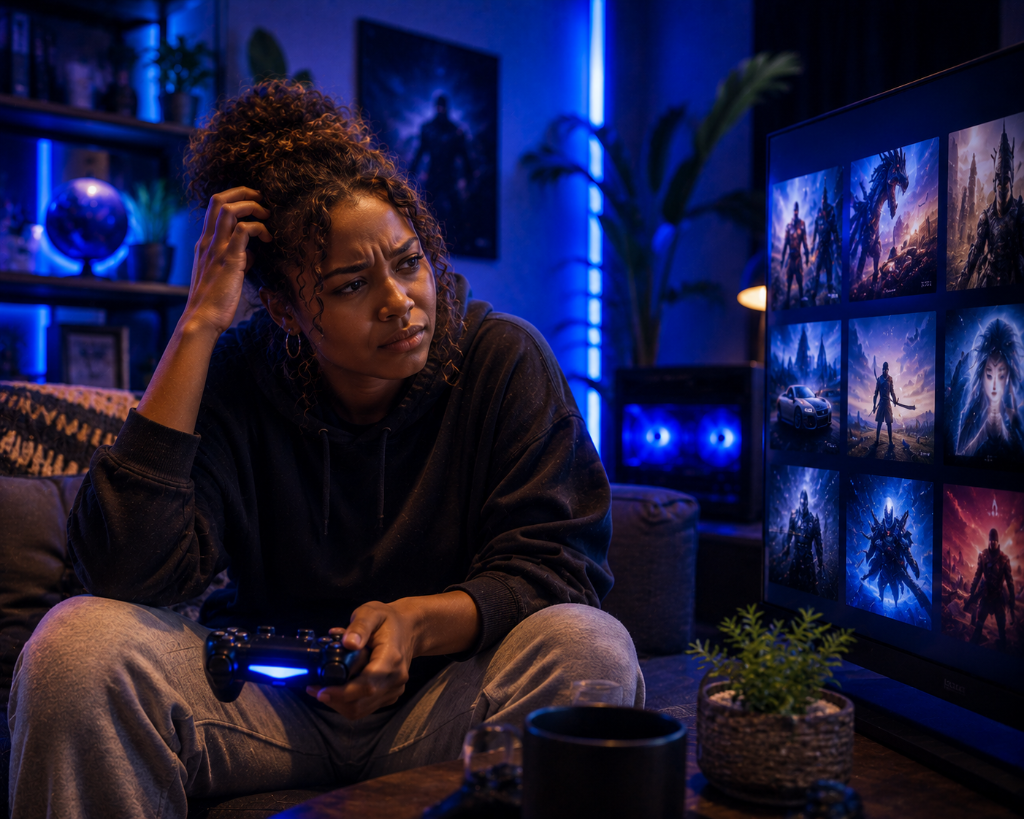
Choosing a game can feel more stressful than expected when you are new.
At first, it seems simple: pick a game and play. But then the options start piling up. Popular games, indie games, free games, paid games, story games, action games, cozy games, competitive games, long games, short games, and reviews from people who already know what they like.
For someone exploring video games as a hobby, this can turn curiosity into hesitation.
You may wonder:
“Is this game worth my time?”
“What if I buy it and regret it?”
“What if everyone likes it, but I don’t?”
“Should I trust reviews or my own curiosity?”
“What if I keep choosing wrong?”
Those questions are normal. Game choice anxiety happens when a simple decision starts feeling like a test you have to pass.
But choosing a game is not about proving you have perfect taste. It is about making a reasonable first pick, trying it, and using that experience to learn what fits you.
The goal is not to remove all uncertainty before you play.
The goal is to make the choice small enough that you can move forward.
Looking for more beginner-friendly gaming topics? Visit the XP Levels Blog for simple guides that help you explore video games as a hobby without turning every choice into pressure.
Stuck Before the Game Even Starts
Imagine someone who wants to try gaming but does not want to waste time or money.
They open a game store and start browsing. One game has great reviews. Another is on sale. Another looks relaxing. Another is popular with friends. Another has beautiful graphics but seems complicated.
They click one game, watch the trailer, read a few reviews, then hesitate.
“What if this is not the right one?”
They click another game.
Same problem.
After a while, they are not choosing anymore. They are second-guessing.
Instead of playing, they are trying to guarantee the perfect decision.
Now imagine a different beginner.
They accept that they cannot know everything before playing. Instead of looking for the perfect game, they look for a safe test.
They choose one game that matches their current interest, budget, time, and comfort level. They decide ahead of time that the first session is only a trial, not a lifetime commitment.
They play for a short time.
Maybe the game clicks.
Maybe it does not.
Either way, they learn something useful.
That is the difference between being stuck and exploring.
One person treats the choice like a final exam.
The other treats it like a small experiment.
A Good Pick Is Better Than a Perfect Pick
Game choice anxiety becomes easier to handle when you stop asking, “What is the perfect game?” and start asking, “What is a good enough game to try next?”
That question lowers the pressure.
A beginner cannot always predict what they will enjoy. Games are interactive. A trailer can show you how a game looks, but it cannot fully show how the controls feel, how the pace feels, how the difficulty feels, or whether the main activity will hold your interest.
Reviews can help, but they cannot decide for you.
Popularity can help, but it does not guarantee personal fit.
Recommendations can help, but they come from someone else’s taste.
Your own reaction matters.
This is why choosing games works better when you translate the decision into useful outcomes.
Instead of asking, “Is this the best game?” ask:
Does this game match something I am curious about?
Can I try it without too much risk?
Does it fit the time I have?
Does it seem understandable for my current experience level?
Can I stop or switch if it does not fit?
Will this choice teach me something about what I enjoy?
That is a more practical way to choose.
You are not choosing the “right” game forever.
You are choosing the next game that gives you information.
Reviews, Popularity, and Curiosity
A major source of game choice anxiety is not knowing what to trust.
Reviews can be useful, but they should be treated as clues, not commands.
A review score can tell you that many players liked a game, but it cannot tell you whether the game matches your patience, schedule, mood, or interests.
Popularity can also be useful. Popular games often have more guides, larger communities, and more beginner help available. But popular games can also be fast, competitive, complex, or built for players who already understand the genre.
Your own curiosity matters too.
If a game keeps catching your attention, that is worth noticing. Curiosity is not proof that you will love the game, but it is a strong reason to test it.
A balanced beginner approach is:
Use reviews to spot warnings.
Use gameplay previews to understand the pace.
Use price, demos, or subscriptions to manage risk.
Use your curiosity to choose what feels worth trying.
This makes the choice less emotional and more manageable.
What to Ignore for Now
When choosing games, ignore anything that makes the decision feel bigger than it needs to be.
Ignore “must-play” lists.
Ignore arguments about the greatest games ever made.
Ignore the pressure to play what everyone else is playing.
Ignore review scores as the only deciding factor.
Ignore fear of missing out.
Ignore huge game backlogs.
Ignore collector’s editions.
Ignore advanced builds, rankings, and expert strategies.
Ignore the idea that choosing a game means committing to finish it.
Ignore the belief that disliking a popular game means you are wrong.
For now, focus on simple decision points:
Does this game interest me?
Can I try it safely?
Does it fit my current mood and time?
Does it look manageable?
Can I learn something from playing it?
That is enough.
Common Game Choice Mistakes
If you feel unsure after choosing a game, it does not mean you made a bad decision.
It may mean you are still learning your taste.
If you buy a game and do not enjoy it, it does not mean you failed.
It may mean the game was not the right fit, or the timing was wrong.
If reviews made the game sound better than it felt, it does not mean reviews are useless.
It may mean you need to read reviews for specific clues instead of final answers.
If you dislike a popular game, it does not mean gaming is not for you.
It may mean that game’s pace, genre, difficulty, or main activity does not match your interests.
If you hesitate to try indie games or unknown titles, it does not mean you are closed-minded.
It may mean you want lower-risk ways to test them first, such as demos, short gameplay videos, sales, or subscription access.
If you keep second-guessing, it does not mean you are bad at choosing.
It may mean the decision feels too expensive, too permanent, or too tied to your identity.
The solution is to shrink the decision.
Make the first step smaller.
Choose, Test, Learn
Choosing games gets easier through repeated small decisions.
Pick one reasonable game.
Play one short session.
Notice your reaction.
Ask what worked and what did not.
Use that information for the next choice.
Repeat.
For example:
If you liked the story but disliked the combat, look for story-focused games with easier combat or adjustable difficulty.
If you liked the visuals but felt bored, look for games with clearer goals or more active play.
If you liked the idea of multiplayer but felt pressured, try casual co-op with one trusted person.
If a popular game felt too intense, try a slower beginner-friendly option.
If an indie game surprised you, explore more games with similar mood, style, or mechanics.
If you regret a purchase, pause before buying another game and identify what did not fit.
This loop makes every choice useful.
Even an imperfect pick can teach you what to choose next.
Before Choosing
Before choosing a game, ask:
What kind of experience do I want right now: relaxing, exciting, creative, social, story-based, puzzle-based, or skill-based?
How much time do I want to spend in one session?
What is my comfortable budget for this choice?
Can I try a demo, free version, subscription option, sale price, or gameplay preview first?
Does this game look beginner-friendly?
Am I choosing this because I am curious, or because I feel pressured?
What would make this game worth trying, even if it does not become my favorite?
What is the smallest safe way to test this choice?
These questions help you choose with direction instead of guessing.
While Playing
While playing, ask:
Am I enjoying the main activity?
Do I understand what the game wants me to do?
Is the game matching the experience I expected?
Do I feel curious enough to keep going?
Is the difficulty manageable?
Am I playing because I want to, or because I feel like I need to justify the choice?
What is this game teaching me about my taste?
Would I try another game like this, or something different next time?
These questions help you stay connected to the actual experience instead of staying stuck in the decision you made before playing.
After Doubt or Regret
After doubt, regret, or second-guessing appears, ask:
What made me unsure?
Was the issue the price, the game style, the difficulty, the pace, the controls, or my expectations?
Did I give the game a fair short try?
Did I enjoy any part of it?
Would adjusting settings help?
Would a different game in the same style fit better?
Should I continue, pause, refund if possible, or move on?
What should I look for next time?
How can I make the next choice lower-pressure?
These questions help you respond to regret without turning it into a reason to stop exploring gaming altogether.
You Do Not Need Perfect Certainty
It is normal to feel uncertain when choosing games as a beginner.
Gaming is a broad hobby. There are many types of games, and you will not know your taste immediately. Some choices will surprise you. Some will disappoint you. Some will feel interesting for a while and then fade. Some will become favorites.
That is part of learning the hobby.
You are allowed to start with popular games.
You are allowed to start with smaller games.
You are allowed to trust reviews for clues.
You are allowed to trust your own curiosity.
You are allowed to stop playing a game that does not fit.
You are allowed to make a few imperfect choices.
Choosing a game is not a test of whether you belong in gaming.
It is simply one step in discovering what kind of gaming experience feels worth your time.
Choose the Next Small Test
Game choice anxiety is like standing in front of a huge menu at a restaurant. Reviews can help. Popular dishes can help. Recommendations can help. But eventually, you learn your taste by trying something.
Start with one reasonable pick.
Choose a game that matches your current interest, time, budget, and comfort level. Play a short session. Notice what worked and what did not. Then use that information to choose better next time.
Do not wait for perfect certainty.
Video games as a hobby become easier to explore when every choice is allowed to teach you something.
Ready to compare safer game options before choosing? Continue your journey in Exploring Gaming, where you can discover beginner-friendly genres, play styles, and game paths that match your curiosity without pressure.
Leave a Reply